What Slow Data Really Costs Your FBO?

When data can’t keep up with the pace of the ramp, teams are forced to react rather than plan. Over time, this operational lag incurs costs — wasted hours, mistimed fuel orders, and customers who don’t return.
Fixed Base Operators work in fast-moving environments where fuel trucks, ground crews, aircraft arrivals, billing cycles, and maintenance holds are all in motion at once, on razor-thin margins. Every decision has a direct impact on the bottom line, and yet many FBOs still make those decisions with data that’s hours, or days, out of date.
The cost of slow data never shows up as a single line on the books; it’s spread across dozens of small moments instead. It hides in the fuel truck sent out for a tail that has already departed, the line tech who waits an hour for an arrival that slipped, the charter invoice that goes out three days late. Nothing breaks loudly enough to investigate, so each incident gets absorbed into the day as the normal friction of a busy operation. And yes, some of that friction comes with the territory, but much of it is fixable at the moment data keeps pace.
Individually, these minor disruptions seem too small to chase, but that is exactly how they compound into significant losses. A few loads tankered that weren’t needed, an invoice or two that slips its cycle, one overstaffed shift a week: each is a rounding error on its own. Stack a quarter of them together and you’re staring at the margin you went hunting for everywhere else.
Why Data Latency is an Operations Problem?
Latency, not access, is the real constraint. Most teams have the data; it just arrives after the moment it could have changed the call. So, they bridge the lag with instinct and memory, usually well enough to get through the day, but every guess that fills the gap leaves behind duplicated effort, a missed signal, or a risk that compounds the next time the same gap opens.
These patterns hold across FBO operations of all sizes: information that lives in one system, or in someone’s head, or gets entered at the end of a shift, creates drag at every handoff. The consequences — a delayed customer, an understaffed ramp, or a billing error — might seem small in isolation. Add them up across a month, and they often become the difference between an operation that feels in control and one that’s always playing catch-up.
The Real-World Cost: Reactive vs. Proactive
Slow data does its damage in pieces, and the common thread across all of them isn’t bad people or broken processes — it’s timing.
Here are five everyday situations that play out in an FBO when your team is a step behind, versus when the data reaches them in time to act.
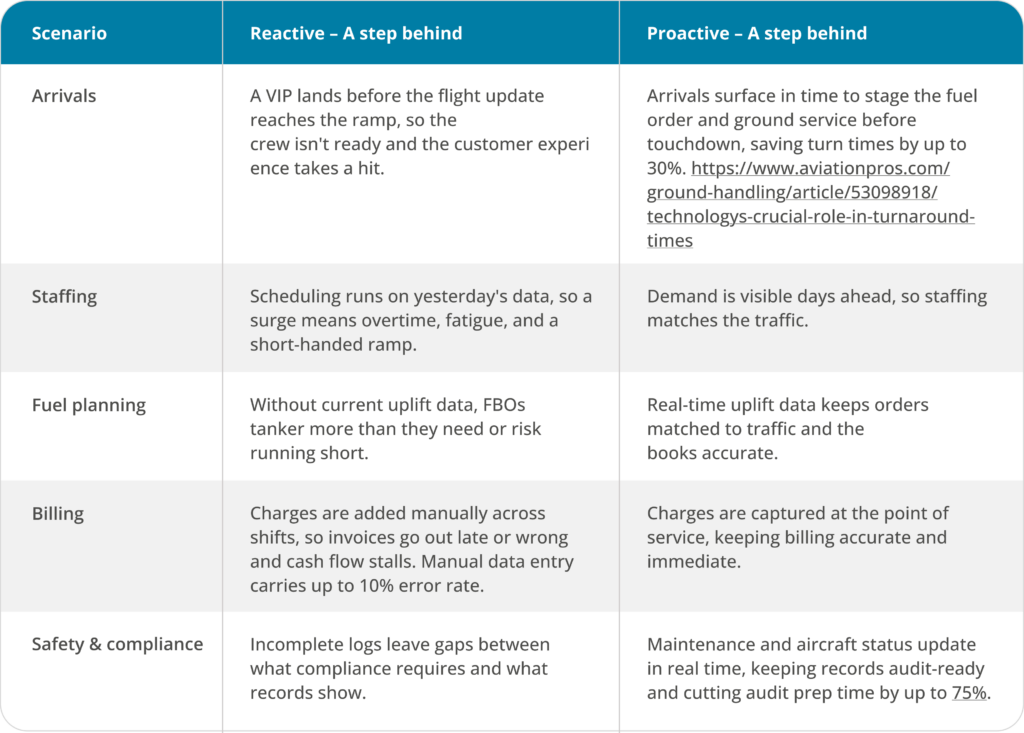
Put simply, a reactive operation treats data as a historical record, while a proactive one treats it as a tool for the future.
What Timely Data Actually Enables?
When the people making decisions have the latest information, the whole operation runs more smoothly — not because anyone works harder, but because nobody is doing guesswork. It also narrows the margin for error. Real-time updates to maintenance status, aircraft holds, and compliance records allow personnel to act based on a complete, accurate operational picture rather than piecing together fragments after the aircraft has departed.
The financial advantages compound across the business:
Improved Cash Flow:
Faster, more accurate point-of-sale billing reduces Days Sales Outstanding (DSO) — across industries, accounts-receivable automation has been shown to cut DSO by 15–30 days, freeing working capital that would otherwise sit in unbilled charges.
Reduced Waste:
Tight inventory management prevents fuel and resource leakage.
Asset Optimization:
A clear view of ramp utilization ensures personnel and equipment are deployed where they generate the highest returns.
Closing the Gap, One Handoff at a Time
Transitioning to a real-time operation is not a matter of telling your team to work harder or report more data; it is about changing where and how that data is captured. The goal is to move from manual, delayed logging to an integrated digital workflow.
In practice, this operational shift relies on three connected steps:
Mobile Capture at the Wing:
Instead of clipboards and delayed shift logs, line technicians use mobile tablets on the ramp to input fuel uplifts, catering drops, and service completions the moment they happen.
Instant Front-Desk Visibility:
The second a technician logs a service at the aircraft, that data automatically populates at the customer service desk. The front-desk agent does not need to call the ramp via radio to confirm a fuel order; it is already on their screen.
Automated Billing:
Because the ramp data connects directly to the core billing system, the invoice is built automatically. When the pilot walks up to check out, the bill is complete, accurate, and ready for payment, eliminating delayed invoicing and missed charges.
This is the exact operational gap Total FBO was built to close. It replaces isolated spreadsheets and manual tracking with a single, live system that connects the ramp, the front desk, and the back office. Your team does not do extra work; they simply enter data once, at the point of service, so the entire operation can act on it immediately.
The FBOs that close this gap stop quietly paying for operational lag. By running their business on what is happening right now rather than what happened last shift, they protect their margins, eliminate administrative drag, and secure the trust of the crews who keep coming back.
Ready to uncover the hidden costs in your operation? Schedule an operational consultation with the Total FBO team today.